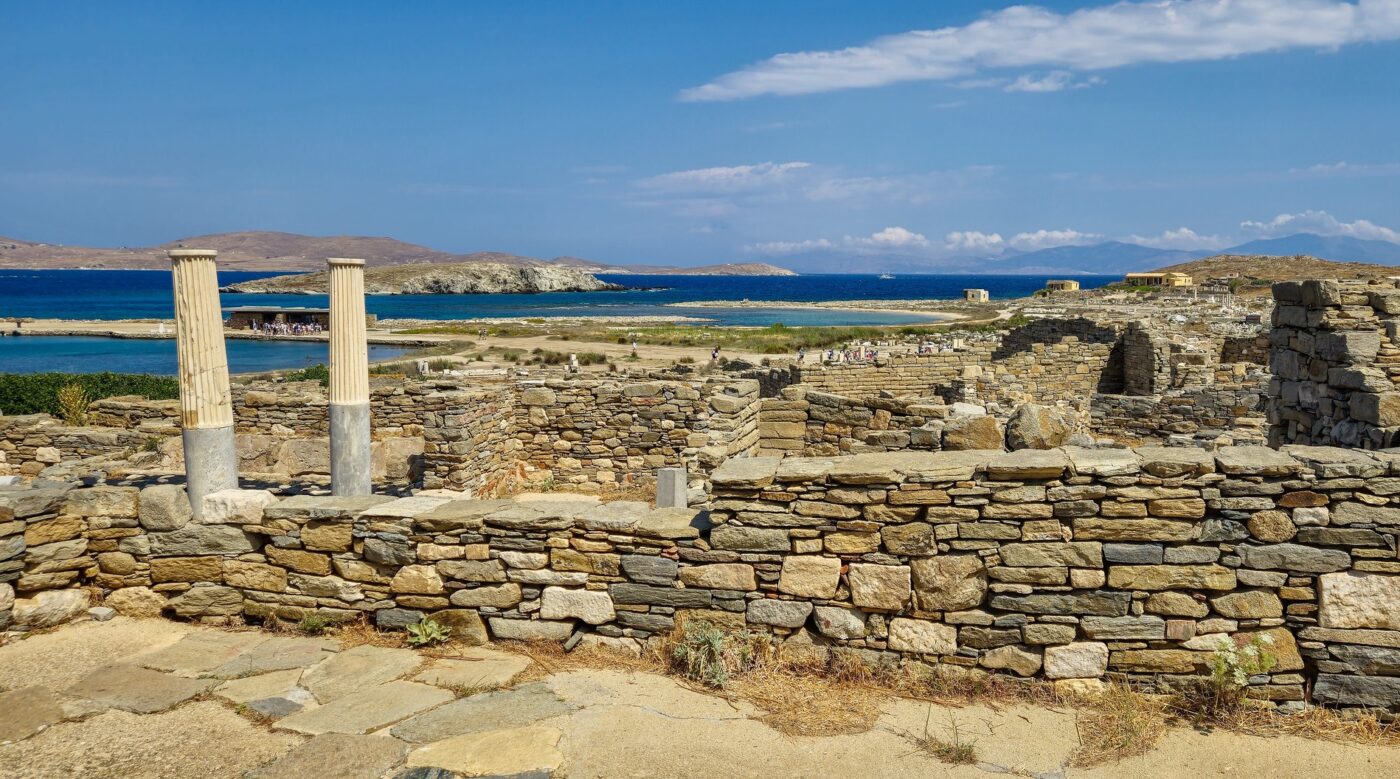
Delos was the spiritual center of the ancient, Greek world. It is one of the most important mythological and archeological sites in Greece. The tiny island is a World Heritage Site with a unique vibe only accessible by boat. Even more, the next generation may be one of the last to see Delos because the island is sinking. Join me for a Delos, Greece archeological tour and discover why you must visit.
Getting to Delos and Admission
Roundtrip ferries go between Old Port in Mykonos Town and Delos. These operate April through October, taking about 30 minutes each way. Admission to Delos is 20 Euros. Visitors can explore on their own or guided tour.

About Delos
In the center of the Cyclades Archipelago of the Aegean Sea, Delos lies near Mykonos. This small island is one of the most important archeological sites in Greece. The entire island is a World Heritage site, undergoing constant excavations.
No inhabitants are allowed on Delos, and it’s accessible by a 30-minute ferry ride from Mykonos. Many of its ancient artifacts are housed at the Archeological Museum of Delos and National Archeological Museum of Athens.
Delos was an important site during 4 key eras: Ancient, Classical Greece, Hellenistic and Roman times. It became inhabited by third millennium BC. Initially, it was a sacred pilgrimage site for the ancient Ionians.
It became the sanctuary for Apollo, god of daylight and Artemis, goddess of moonlight. This period lasted from about 900 BC to 100 AD. According to mythology these twin gods were born on Delos from Leto, a mistress of Zeus. Hera, Zeus’ jealous wife, forbade any land be allowed for Leto to give birth. However, because Delos was a floating island, Leto could break the curse and give birth. Then, Poseidon anchored Delos in the sea.
Under the urge of the Delphic Oracle, all dead bodies became purged from the island. No burials or births were allowed on Delos. During the Hellenistic period, a Phoenician colony established large trade relations in Delos.
The island imported most of its food and timber. An extensive cistern and aqueduct system with wells and sanitary drains managed limited water supply. Various agorae or markets is where people gathered.
Delos Roman Era, Decline and Resurrection

The Romans took over and converted Delos into a free port during the first century BC. They ceded it to the Athenians and expelled its inhabitants. Delos became the international trading center for Greece and reached a population of 30,000 inhabitants. Also, it developed the largest slave market in the region.
Before the end of the first century BC, trade routes changed. Delos sharply declined and eventually became abandoned in the eighth century AD.
The ancient ruins of Delos were rediscovered and excavated in 1873 by the French School of Athens. It was preserved mainly because it was remote and uninhabited since the eighth century AD. The excavations have continued since the 19th century, with it becoming a World Heritage Site in 1990.
However, Delos is Sinking!
This is why you and the next generation may be one of the last to visit Delos. The island is sinking in the Aegean Sea about 1 cm/year. Scientists believe Delos is sinking because of the rising seas and tectonic subsidence. Their estimates predict that the island could be underwater in 50 years.
Check out my YouTube Video!
Delos, Greece
Archeological Tour Highlights
I took a guided tour of the island, gathering in Mykonos for the 30-minute ferry ride to Delos. Our walking tour lasted for about 3 hours. The guide took us to important landmarks with extensive commentary on history, mythology and archeology. She did a fantastic tour bringing this mysterious island to life. I share the important landmarks and insights explored in the order of our tour.

Sacred Way from Harbor to Apollo Sanctuary
Our tour started from the Sacred Harbor with the backdrop of Mt. Cynthus. This rocky hill is the birth place of Apollo and Artemis. It’s the island’s highest point at 112 m with a 1-mile, roundtrip hike to the summit. We followed the Sacred Way, a processional avenue from the Sacred Harbor to Apollo Sanctuary.
Our first stop was the Hellenistic Agora of the Competaliasts, dating back to 2nd century BC. I observed the round marble monument from the Ionic temple dedicated to Hermes. Also, nearby is a bust of Hermes, the Greek God of Commerce.
In the northern portion of the agora is the Portico of Philip V, King of Macedonia. Covered in scaffolding, this landmark was constructed as a magnificent building during the Period of Independence from 314 – 166 BC.
Temples of Apollo, Sacred Lake
& Terrace of Lions

Three Apollo temples stood on the island for the Athenians, Poros and Delians. Temple of the Delians was the largest of the 3, started in 5th century BC in the Doric order. Here, once stood a colossal kouros of Apollo.
The Sacred Lake was dried out intentionally to eliminate the malaria-spreading mosquitoes. A symbolic palm tree marks the birthplace of Apollo and Artemis. According to the myth, Leto clutched a palm tree while giving birth to the twins along the shores of the lake.
Terrace of the Lions faces east towards the Sacred Lake, protecting the island. They were dedicated to Apollo by the people of Naxos. Originally 9 -12 marble lions served as guardians along the Sacred Way. Today, five lions remain on site. This monumental avenue was like the Egyptian Avenues of Sphinxes.
Friendly Cats of Delos

Cats were brought to the island to manage the rodent population. They are mostly friendly and will greet you. The guides all bring cat food and the cats know them well.
More Temples & Terrace of Foreign Gods

Various temples honored the Greek Gods and Goddesses. Zeus and Athena sanctuary ruins lie near the peak of Mt. Cynthos. The Temple of Hera honored Zeus’ consort. The Stoivadeion was dedicated to Dionysus the God of Wine. Its pillar supports a colossal phallus, the symbol of the Dionysian life force.
Once the Romans claimed Delos as a free port for international trade, the island created temples from other religions. The Terrace of the Foreign Gods featured this. The Doric Temple of Isis honored the Egyptian trinity of Isis, Serapis and Anubis. Also, the Syrian Gods shrine honored Hadad and Atargatis. In addition, the Delos Synagogue is believed to be for the ancient Samaritans.
Delos Wealthy Houses and Mosaics

Rich merchants built fancy homes and villas with mosaics and frescoes. The House of Dionysus was a luxurious private home from the 2nd century. It is named after its floor mosaic of Dionysus riding a panther. Similarly, the House of Dolphins is named after its atrium mosaic. It features erotes riding dolphins. Also, House of the Trident features panels with a dolphin around anchor and trident.
Delos Theatre

The Delos Theatre was one of few ancient Greek theatres built completely in marble. Its capacity seated 6,500 spectators and became designed for water catchment.
The theatre cistern was an underground reservoir built to collect rainwater and runoff of theatre seats. Today, its granite arches that supported the roof can be seen.
Enjoy Delos!
This island is so fascinating on so many levels. Besides the incredible history here, the island is surrounded by beautiful blue waters. There is a magical vibe that is unique for a archeological site. I loved my experience here and recommend taking a guided tour. A guide can help bring the marble and stone to life with history and myth. If your travels bring you to Delos, feel free to leave comments below.
Read Next!
One Day in Delphi: Exploring Greece’s Ancient Spiritual Center
Incredible Olympia, Greece Ruins Tour – Birthplace of Olympics