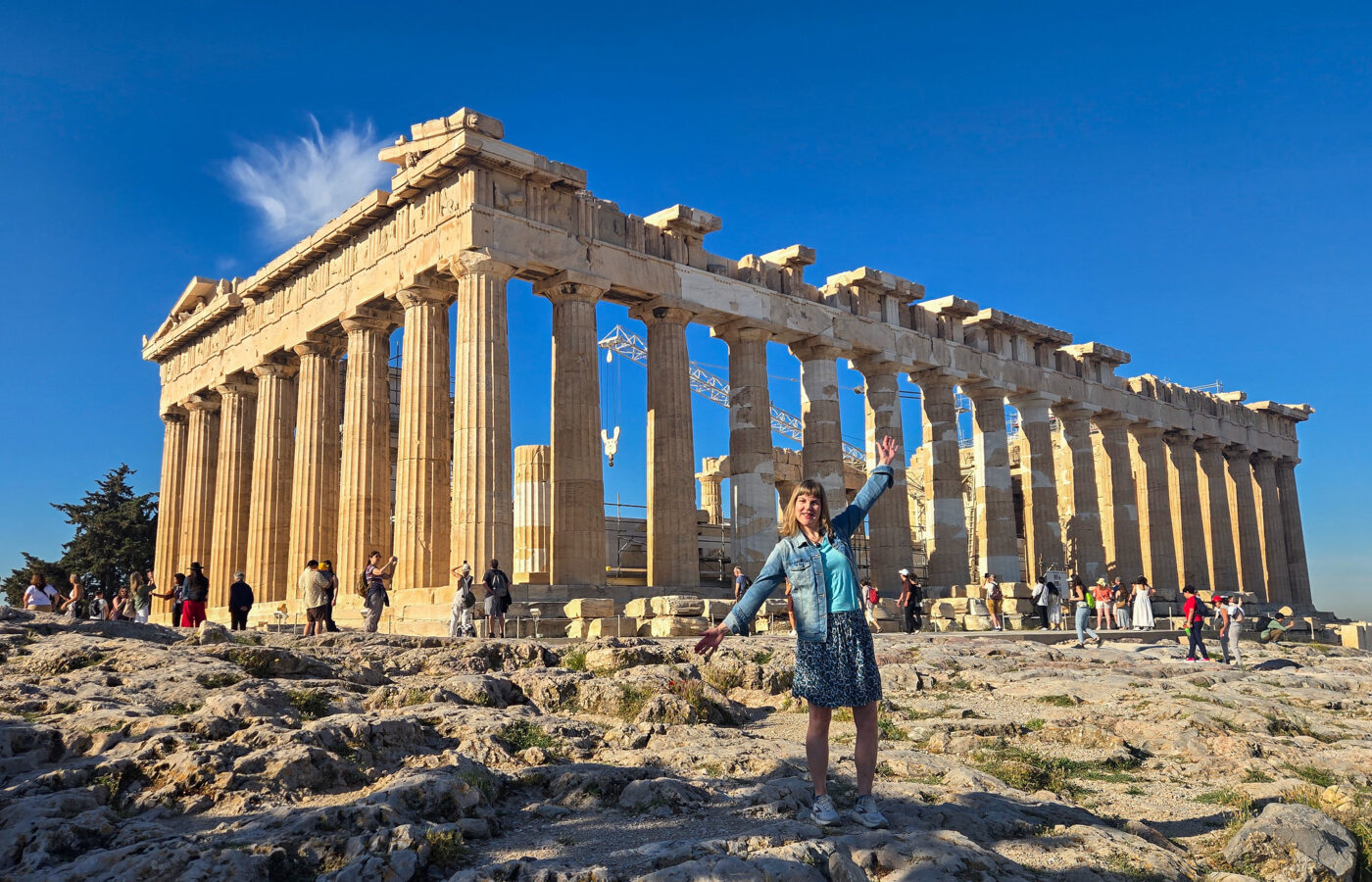
As the birthplace of Western civilization and democracy, Athens is a treasure trove for archeology, museums and food. Many tourists visit the Acropolis, then move on to the Greek islands. After doing a deep dive during my 10-day stay, I make the case that Athens is a wonderful hub for a long visit. I spent every minute of my stay exploring and love to share. So, read on and discover from my Athens, Greece Travel Guide for the “Classic City.”
Athens requires planning, pure and simple. Most noteworthy, the iconic sites are in the pedestrian neighborhoods in city center near Acropolis. Once you start to venture in outlying areas, the traffic can be daunting.
So, stay in neighborhoods near the Acropolis, such as, Plaka, Monastiraki, Syntagma and Psirri. Athens circulates great tourist maps, making navigating the city easy. Many of these places are within walking distance. If your site is too much for walking, consider the Metro.
Athens Metro Transit
The Athens Metro system is convenient and easy to operate. The Metro subway goes from the airport to most major squares in Athens and even Piraeus. From the station, just buy a ticket (options for English) for number of stops or day pass. Then, you scan your ticket and are free to choose your terminal, all well-marked. This will save you lots of money instead of taxis and time from walking.
Where to Stay in Athens
Once again, stick to the pedestrian neighborhoods in city center or nearby for accommodations. However, these neighborhoods will be more expensive, but save you a lot of time. One way to get the best of both worlds (proximity and budget) is to stay near but not in these neighborhoods. I stayed near Omonia Square, a 15-minute walk to the popular Monastriaki Square.
On a tight budget, my stay at Athens Hawks Hostel was perfect. It cost just $25/night for a dorm room. It offers a rooftop bar with dorm or private rooms, kitchen, storage and laundry area.
Check out my YouTube Video!
Athens, Greece Travel Guide
by Neighborhood
Attractions, Food and Culture

Acropolis Area Attractions
What is the Acropolis?
The Acropolis of Athens is a “high city” or citadel that sits on a rocky upcrop above Athens. During the Greek Golden Age or fifth century BC, Pericles, the political leader, coordinated the creation of the site. It’s main 4 building comprised of the Parthenon, Propylaea, Erectheion and Temple of Athena Nike.
The Acropolis crowned the celebration for the Greeks winning the war with Persia. It is dedicated to Athena, the patron Goddess of Athens.
Planning for Acropolis or “High City”
During May – September, it’s best to order tickets online. Otherwise, you will wait in a very long line and maybe not even get in for the day. There are 2 entrances to the Acropolis. The main entrance is on the western end of the Acropolis. The side or Dionysian Theater entrance is on the southeastern side, near the Acropolis Museum. It’s ideal to start and one entrance and exit the other. The one offers close up views of the Dionysus and Odeon stadiums.
The main entrance provides skip-the-lines tickets, guided tours and wheelchair access. The side entrance offers shorter lines and close up views of the Theatre of Dionysus.
Practical Tip: The marble steps and pathways are very slippery. It’s common sense to wear good shoes. Plus, be mindful that the Acropolis will be even more slippery on rainy days.
Acropolis 4 Main Buildings and 2 Theaters

Propylaea
This provides the gateway to the Acropolis, intended to be the transition from the secular to sacred world. It’s built with Pentelic marble and Doric columns. Here, you walk up stairs through the central passage entering the breathtaking views of the Parthenon and Erectheion.
Site of Athena Promachos Statue
After coming out of the Propylaea to the left is a field where the bronze statue of Athena Promachos once stood. (A replica of this statue is in the National Archeological Museum.) The statue was about 9 meters high and seen below from throughout Athens. Moreover, it symbolized the gratitude for Athenian victories in the Greco-Persian War.

Parthenon
The Parthenon was dedicated to Athena Parthenos (Virgin). It was built to celebrate the Greek victory over the Persians. Even more, it’s the largest Doric temple constructed in Greek history. Built in Pentelic marble, it’s surrounded by 8 columns on the short side and 17 on the long side. Most importantly, it’s the symbol of Classical Greece and the Birthplace of Democracy.
The Parthenon’s rich sculptural decorations were preserved, with most of the displays in the Acropolis Museum. In 2025, for the first time in years, they removed much of the scaffolding. Some say this is the least amount of scaffolding covering the Parthenon in 200 years.

Erectheion
When you enter from the Propylaea the Erectheion lies to the left overlooking the city. This sacred Ionic Temple symbolizes Athena winning the contest with Poseidon on becoming the Patron Protector of Athens. The architecture is unique because it is asymmetrical.
Another of its highlights is the Porch of Maidens or Caryatids, 6 statues designed as columns. On side are replicas. Five of the original statues are in the Acropolis Museum and one is in the British Museum.
Also, don’t miss the olive tree on the side facing the city. According to myth this olive tree is the result of Athena winning the contest over Poseidon. She threw her spear at a rock and this olive tree grew from it. Whereas, Poseidon threw his trident into a rock creating a salt spring, that didn’t impress the Athenians as much. This temple housed the wooden, cult statue of Athena Polias.

Temple of Athena Nike
Perched on the southwest corner of the Acropolis on the edge of a cliff is the Temple of Athena Nike. This Ionic temple is the smallest at the Acropolis. It celebrates Athena representing Nike, the Greek Goddess of Victory. You can’t get near it. So, don’t miss it from the Propylaea entrance or on top the hill.

Odeon of Herodes Atticus
Built in AD 161, this stone Greek theater is located on the southwest slope of the Acropolis. It is named after the orator Herodes Atticus. He built it in memory of his Roman wife and gifted it to the city. It was used as a Roman theater with a semi-circular shape. The capacity was 5,000 with 33 rows of marble seats. The theater’s entry portico was a mosaic floor. The venue was used for music concerts until destroyed in 267.
The venue was restored in the 1950’s with Pentelic marble. Today, the venue is used for the Athens Festival, running May through October each year. The only way to see the theater up close is by attending a performance or from the Acropolis.
Theatre of Dionysus
This 4th century BC theater is considered the birthplace of European theater. Here, famous classical Greek dramas performed. Sophocles, Aeschylus, and Euripides all premiered here. Festivals honored Dionysus here, seating 17,000 spectators. It’s not as preserved as the Odeion. The best way to see it is taking the southeastern side entrance to the Acropolis.
Areopagus or Mars Hill

Don’t miss Mars hill, near the main entrance of the Acropolis. It offers a 360-degree panoramic view of Athens, Ancient Agora and the Acropolis up close. It’s a scramble on stones to get out to the edge, but the pictures are worth it.
Photo Tips: Late afternoon/sunset is the best time for pictures of the Acropolis with best lighting.
The hill is considered the first Supreme Court of Athens, vindicating the God of War, Aries from his crime. It also was a meeting spot for Apostle Paul. So, the spot is iconic for mythology, Christianity and common law.
Two stairways take you to the hill. The metal ones on the side of the Acropolis are much less slippery than the other one.
Acropolis Museum

This museum is near the southeast entrance of the Acropolis. It houses much important artwork from the Acropolis buildings, such as statues and friezes. Like the Acropolis, you can purchase skip-the-lines tickets online for high season.

The ground floor houses the Gallery of Acropolis Slopes. Artwork comes from the Sanctuary of Asklepios “God of Medicine” and Theatre of Dionysus “God of Wine.” Examples of important artwork include Mask of Dionysus, Relief Plaque of theatre masks and Pillar with face offering to Asklepios.
Floor 1 displays the Archaic Period and art from the Erectheion. 5 of the 6 Caryatids or “Porch Maidens” are here. They served as Erectheion columns with intricate hairstyles and drapings. This is one of the main attractions of the museum. Even more, other highlights include the Erectheion Frieze, statue of Nike Adjusting her Sandal and Portrait of Alexander the Great.
On Floor 2 is a restaurant with balcony view of the Acropolis. Also, a shop and multi-media center are here.
On Floor 3 is the Parthenon Gallery housing iconic sculptures and friezes. The Parthenon Frieze is a continuous low-relief sculpture showing the Panathenaic procession. The layout mirrors the original positions on the temple.
Ancient Agora of Athens

Near the Acropolis, this archeological site was the marketplace and gathering location for 5,000 years. A map sign offers guidance on finding 36 important points of interest, such as temples, building or stoas.
There are 2 important sites to see in the agora. The Temple of Hephaestus is a well-preserved Greek temple. Built in the 5th century BC, it honors the God of fire and metalworking. The Stoa of Attalus became reconstructed to house the Museum of Ancient Agora.
Philopappos or Hill of the Muses

This park is located southwest of the Acropolis. It’s one of the best places to take fantastic photos of the Acropolis in the late afternoon or sunset. The incredible green space offers walking trails with Philopappos Monument on top of hill. Also, other important landmarks are Socrates’ prison cave and the Dora Stratou Theatre.

Photo Tip: Philopappos Hill is one of the best places to take photos of the Acropolis, especially in the late afternoon and sunset.
Plaka Neighborhood

This is the oldest neighborhood in Athens, spread around the eastern and northern slopes of the Acropolis. It’s built on top of the ancient town of Athens. Because it’s near the Acropolis, Plaka is called the “Neighborhood of the Gods.”

With its mazelike pedestrian alleyways, Plaka is overflowing with restaurants, shops and bougainvillea. Main streets in the district include Adrianou and Pandrossou Streets. The Plaka steps on the slope of the Acropolis offers charming restaurants and cafes. Here, at Anafiotika Café, I enjoyed my first mossouka or “Greek lasagna.” I ate at other nice outdoor restaurants near the Roman Forum, such as, YDRIA Greek Bistro and KARYATIDS.
The Roman Agora ruins display in Plaka. There is an entrance fee, however, I was happy enough with the free view from outside the fence. This was the Roman city center. Today, important ruins include the Gate of Athena Archegetis and Tower of the Winds. This well-preserved tower served as a clock and weather station.
Anafiotika residential area lies within Plaka. Its white-washed buildings with blue trim make you feel like you are on a Greek island. The picturesque neighborhood includes mazelike paths with colorful graffiti and the Acropolis looming nearby.
Monasteraki “Little Monastery” Neighborhood

The bustling Monasteraki neighborhood is filled with things to do. Monastiraki Square is named after the Church of the Pantanassa in it. Also, in the square are a metro station, restaurants and the entrance to the popular Monastiraki Flea Market. Open on Sundays, this flea market is one of the best places to shop in Athens.
Roof-top bars line the square with fantastic views of the square and Acropolis. My favorite spot was late afternoon/sunset at the MS Rooftop Bar for drinks and the view of the Acropolis. Next door is the A is for Athens, in Athens Gate Hotel. However, it was under renovation when I was there, so didn’t check it out.
Near Monastiraki Square are a plethora of restaurants and eateries. Savvas Restaurant offers some of the city’s best Greek food with a rooftop garden view. O Thanasis is known for having some of Athen’s best gyros. Lukumades is a fun eatery to indulge in Greek donuts. Traditionally, these are made with cinnamon. However, this trendy place offers delicious options drizzled on top like white or milk chocolate. I loved these Greek donuts.
Hadrian’s Library lies near the Monastiraki Square. This archeological site was built by the Roman Emperor Hadrian in 132 AD. It was a cultural hub with a library, lecture hall and gardens. The most significant remains are the western wall with Corinthian columns. It costs to get inside the site. However, I was satisfied with the views for free outside the entrance.
Psirri Neighborhood

This neighborhood, near Monastiraki is another good place for restaurants, cafes, boutiques and nightlife. In Psirri, Atlantikos is considered one of the best places in Athens for fresh seafood. Liosporos Bistro is a trendy jazz café-ouzeri near Iroon Square.
The popular Varvakios Market or Central Athens Food Market spreads out over a square block. Its fish market is the largest in Europe. Fishmongers display various local seafood, such as, sardines, mackerel, anchovies, shellfish, calamari and octopus. Also, local butchers display their meats and charcuterie. Check out the Krokos (yolk), selling a variety of eggs, from ostrich to free-range chicken. Spices and olives are plenty streetside. The colorful fruits and vegetables are outside across the street. Many food tours stop here to sample.
Tips: Wear closed-toe shoes in seafood market. Mornings are the liveliest times and later in the day is best for bargains.
Outside the market entrance is Mokka one of the best places for coffee in Athens. Since 1922, this historic coffee and roastery offers authentic Greek coffee. I enjoyed some Greek coffee here when visiting the Varvakios Market.
Syntagma Square “Constitution Square”
Located in front of the Royal Palace is the bustling Syntagma Square. This is the most important square for modern Athens. It is a major hub for public transportation, including Athens Metro under the square. Syntagma Square is named after the Constitution granted by the first King of Greece.
There are many vendors and social events happening here. Overall, the square is a great connector between ancient and modern Athens. Also, pedestrian thoroughfares connect Syntagma to Montastiraki Square, such as, Mitropoleos Street.
Old Royal Palace and National Garden Area

The neoclassical Royal Palace houses the Greek Parliament. Every hour the Changing of the Guard Ceremony performs in front of the Tomb of the Unknown Soldier. This monument honors all soldiers that died in combat and sadly remain unidentified.
The Changing of the Guard is one of the most popular events in Athens. Two members of the Evzones, a unit of Presidential Guard, stand watch and perform a ceremonial change every hour. Their unique uniforms represents the Greek warriors’ uniforms worn during the War of Independence in 1821. Every detail is symbolic and distinctive. For example, they wear a fustanella, a kilt-like garment with pom poms on top of shoe toes.
Sundays are the biggest celebration at 11 am, when the entire Presidential Guard and military band marches to the monument. Then, they perform a ceremony in front of the palace.

The National Garden is a large public park surrounding the Royal Palace. It is a wonderful green space oasis in busy Athens. The park offers diverse plant life and trees with walking trails, ponds, small zoo, cafe and ruins. This is a great place to relax and bring a picnic lunch.
Sites Near the National Garden Area
Temple of Olympian Zeus
This is the remains from an ancient temple for the King of the Gods. 600 years in the making, constructed started in the 6th century BCE. However, it wasn’t finished until the 2nd century CE by the Roman Emperor Hadrian. At its prime, this temple consisted of 104 Corinthian columns and house ivory and gold statues of Zeus and Hadrian.
Today, 15 standing columns remain. However, when I went much of the temple was covered in scaffolding. I recommend you take a look from outside for scaffolding to see if it’s worth paying the entrance fee.

Arch of Hadrian
This arch stands outside the fence for the Zeus Sanctuary. Built in 131 AD, it was a gateway between Theseus and Roman city of Hadrian. Don’t miss the inscriptions on the arch. One side says: “This is Athens, the ancient city of Theseus.” Other side says: “This is the city of Hadrian and not of Theseus.”
Photo Tip: A selfie under the Hadrian arch, frames the Acropolis in the background.
Other Sites Near the National Garden
Panathenaic Stadium

This stadium is a fun archeological site, that was the venue for the first modern Olympics. Originally constructed entirely of marble in 330 BC, it became rebuilt in 2nd Century BC.
It is the only stadium in the world built all from marble. You can see a lot outside the gate, but it is interesting to go inside with the audio guide.
I walked the track and up into the marble seats and even sat in the Royal seats. In the green center, tourists, took race starting selfies, kneeling on their knees. I even saw a young man doing backflips. There are organized fun competitions, such as, tug of war.
Aristotle’s Lyceum
These remains are from Aristotle’s philosophical school, focusing on peripatetic teaching while walking. The site features covered walkways, wrestling grounds and gymnasiums. Even though there isn’t much there but crumbled stone, I learned a lot from the signs and enjoyed the peripatetic walking path. I found the 5 Euro entrance fee totally worth it.
Mount Lycabettus

This is the highest point in Athens reaching 909 ft or 277 m. It’s accessible by funicular or a steep, zigzag trail. At the top is a 360-degree panoramic view of Athens, including the Acropolis and even Saronic Gulf. Also, at the summit is a café, Orizontes Restaurant, St. George’s Chapel and Lycabettus Theatre. It’s very popular at sunset, so it gets crowded at this time.
I enjoyed the views about 2 hours before sunset. When leaving, I was amazed at all the tourist entering. So, warning you on this.
National Archeological Museum

This neo-classical designed museum is an absolute treasure trove. It contains the most extensive collection of Greek Antiquity artifacts in the world. These collections include Prehistoric, Sculpture, Vases, Santorini, Metallurgy, Egyptian and Epigraphical. Overall, about 11,000 artifacts display at the museum. However, much more are stored in vaults. The museum is located a 10-minute walk from Omonia Square.
If a Greek history buff, you could easily spend 1 – 2 days here. With over 11,000 artifacts, it’s best to plan ahead with iconic things you wish to see. The museum includes a café and shop. I researched to observe 20 in a half-day self-guided tour, however, missed 3 of them. For starters, here was my list:


20 Artifacts to See at National Archeological Museum
- Mask of Agamemnon
- Writing of Homer and Trojan War
- Sculpture from Epiduras
- Chariot of Diocletian
- Statue of a Fighting Gaul
- Golden Treasure of Karpanesi
- Varvekeon Athena Statue (Parthenon Replica)
- Dipylon
- Cycladic Harp Player
- Ninnion Tablet from Eleusinian Mysteries
- Diadem Bearer
- Statue of Aphrodite and Pan and Eros
- Epinetron of Aphrodite
- Keramiko Funerary Monuments
- Bronze head of Boxer
- Statue of Poseidon on Melos
- Jockey of Artemison
- Antikythera Mechanism-world’s first computer
- Akrotori Collection (Santorini)
- Youth from Antikithera
Popular Athens Day Trips
Get Your Guide – Viator – Local Companies

Cape Sounion and Poseidon Temple
Delphi
Ancient Corinth
Meteroa
Day Cruise to Greek Islands
Enjoy Athens!
I can’t recommend enough considering slow travel in Athens. There is so much to see and do for history buffs. As the birthplace of western civilization and democracy, you can connect with many iconic firsts. The Acropolis was the height of my visit. However, I was emotionally charged by seeing Socrates Prison cave and walking Aristotle’s Lyceum. Bottom line: Athens offers opportunities to connect with the iconic, historical giants in reality and myth. If your travels bring you to Athens, feel free to leave tips or suggestions below.
Read Next!
Incredible Olympia, Greece Ruins Tour – Birthplace of the Olympics
Minoan Palace of Knossos & Heraklion Archeological Museum Guide