
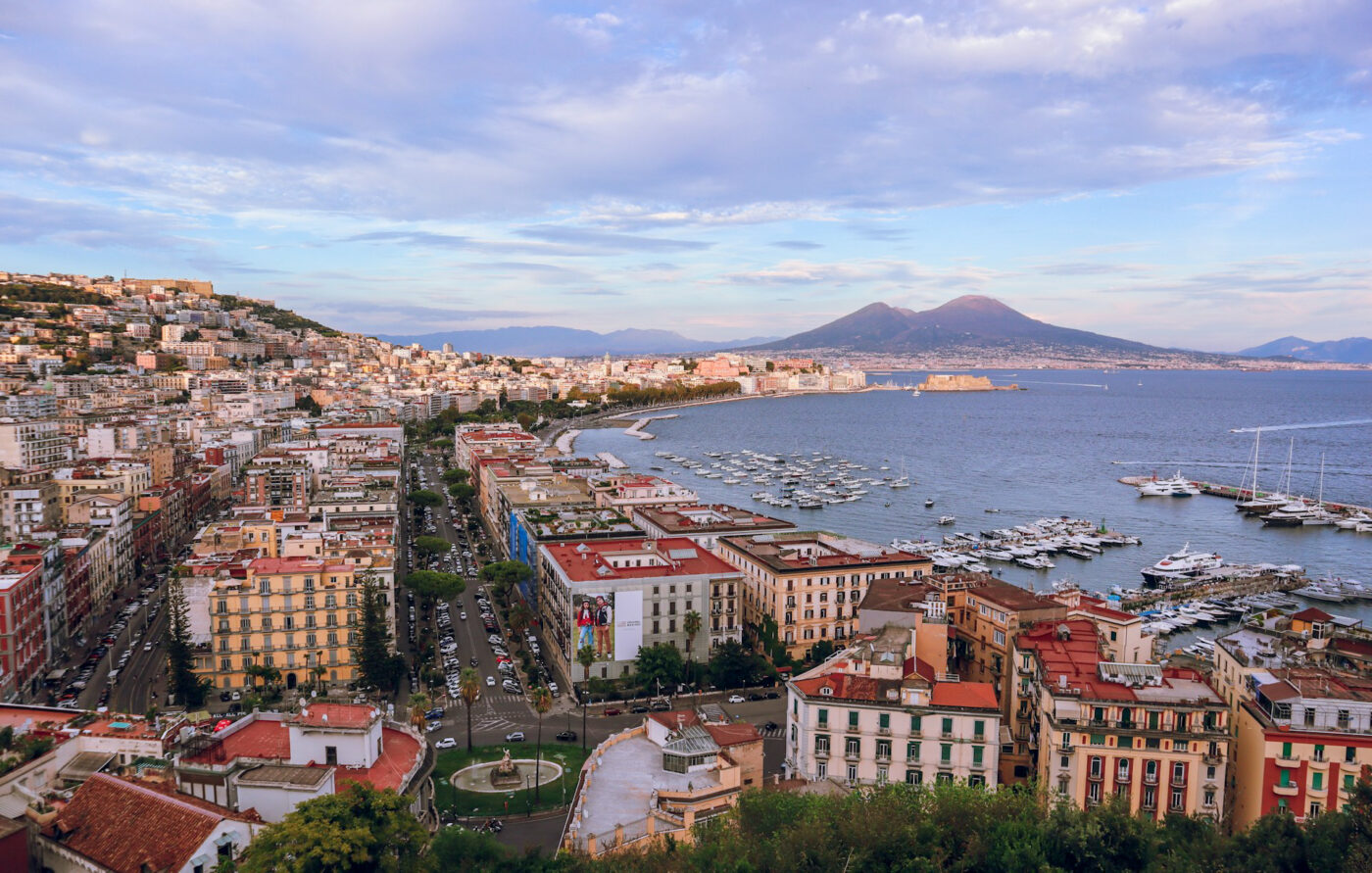
Perhaps, no other city is more Italian than Napoli. Known for being the birthplace of pizza, Napoli is an unpolished version of Italy that authentically captures your heart. On my walking tour, I experienced Napoli as undergoing a Renaissance, restoring its former glory and cleaning up the streets.
As an Acupuncturist-at-Sea, I made many stops in Napoli over the years. To me it was just a stopover for Pompeii, Amalfi Coast and pizza. However, recently it unexpectantly got under my skin while wandering its back streets. So, I made a plan to uncover Naples’ soul to feed my own with more than pizza. Here is what I learned…
Napoli, Full Stop!

Napoli is an underrated destination for food, friendly locals and historic landmarks with Pompeii, Mt. Vesuvius, Capri and Amalfi Coast nearby. In short, Napoli is the soul of southern Italy.
Most cities have a symbol or iconic monument. Rome has the Colosseum, Florence has Michelangelo’s David and Pisa the leaning tower. Napoli has Mt. Vesuvius looming over its bay. This Vesuvian landmark has erupted on the city in many ways. Wander the streets and you will find a chaotic, vibrant and authentic charm.
Historic Centre of Naples
The entire Historic Centre of Naples is a UNESCO World Heritage Site. Established in the 4th century BC by Greek settlers, it was known as Neapolis or “New City.” Naples remained powerful for centuries with various rulers, from the Greeks, the Bourbons, the Aragonese, the Romans to Sicilians. My Napoli Renaissance Walking Tour explored the landmarks and back streets of the Historic Centre of Naples. The best part of all is it’s a compact area that mostly can be explore afoot.
Transforming the “Bad” Side of Naples from the 1980’s and 90’s
Napoli developed a bad reputation for being dirty with problems from waste mismanagement by the mafia, especially in the 1980’s and 90’s. In 1994, the Campania region declared a state of emergency for this disaster. Currently, the government is doing much more to fight this problem and clean up the streets.
Recently, I didn’t notice much concerns about garbage or dirty streets in Naples. In fact, I sensed a deep, local pride and a city reviving itself. It seems to be reclaiming its authentic vitality and repolishing hidden gems. In short, I believe a Neapolitan Renaissance is happening!
My Napoli Renaissance Walking Tour

Many of the important landmarks in Napoli are within walking distance. To truly connect with the essence of Napoli, you need to include aimlessly meandering the backstreets. It is a labyrinth. Almost everything mentioned here, I saw by walking in 3 days, with the exception of day trips.
I found the best way to explore Napoli was to map out the iconic landmarks and wander the backstreets in between. This is where the soul of Napoli reveals itself. I mention the important landmarks in a good flow of order. Not that I followed it, as I unraveled Naples in an intrinsically chaotic way. But, learning from my meanderings, the order that I list landmarks is great for visitors short on time.
Piazza Plebiscite, Naples Royal Palace and Basilica di San Francesco di Paola
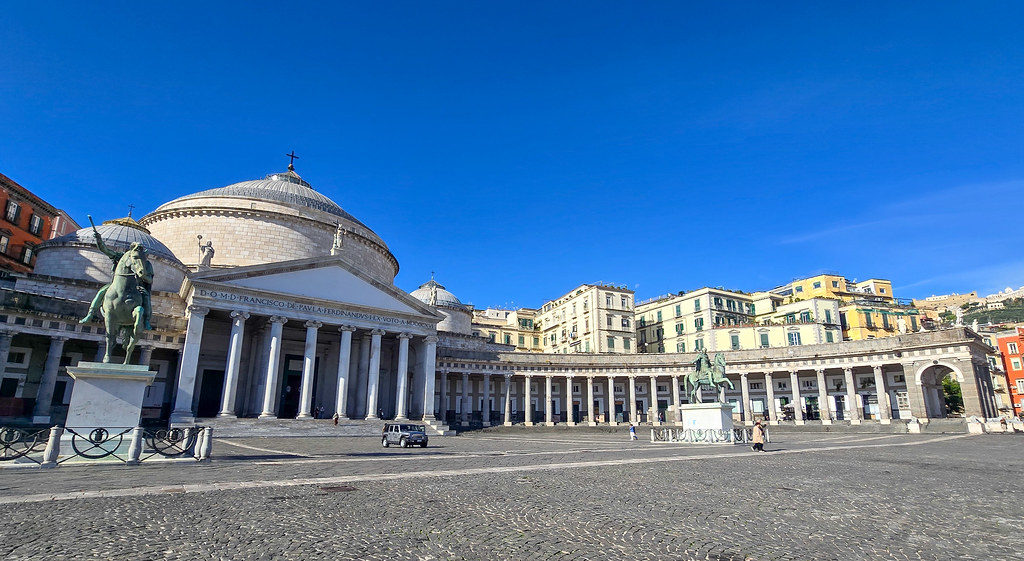
The Piazza di Plebiscite is the main square in Napoli, packed with history. In this square on October 2, 1860, Italians celebrated the unification of northern and southern Italian kingdoms. This massive square takes you back in time to the birth of Italy as a nation. The square is filled with statues, monuments and surrounded by iconic buildings.
The neoclassical Royal Palace of Naples or Palazzo Reale stands on one side of the square. Stand back and notice flanking the palace, Mt Vesuvius on one side and Galleria Umberto I dome on the other. From the 13th through 19th centuries Napoli ruled the southern kingdom of Italy. It was known as the Kingdom of Two Sicilies.
Today, the palace is a museum complex with a Royal Chapel. Overall, the palace displays ceiling frescoes along with Neapolitan paintings, tapestries and artifacts. In 1924 half of the palace became the National Library.
Across from the palace is the Basilica di San Francesco di Paola. This Neoclassical church resembles the Pantheon in Rome. Inside the church is circular with a massive dome in the center.
Galleria Umberto I


I suggest getting to Galleria Umberto I before the shops open. Then, you can explore this elegant shopping mall built in an Italian Renaissance Revival style without the crowds. It’s perfect for photo ops, built in the form of a cross with a large glass dome in the center. Underneath the dome is a large zodiac mosaic on the floor. I enjoyed this mall for photos and seeking out my Taurus bull on the zodiac.
Also, inside the gallery is Sfogliatella Mary. This kiosk features the most popular Neapolitan pastry, the Sfogliatella. Plus, it’s reviewed as one of the best places in Napoli for this treat. The shell-shaped exterior is crunchy with paper thin doe layers. In contrast, the interior is a soft and citrus-flavored with cinnamon for a mouth-watering bite. I agree with the reviews for Sfogliatella Mary as one of the best places in Napoli to enjoy this pastry.
Teatro San Carlo
Across the street from the Galleria Umberto I is the Teatro San Carlo. This neoclassical venue is the oldest continuously operating opera house in the world. Famous performers here include Bellini, Rossini and Paganini. Visitors can catch an opera performance or even a guided tour to learn about its history. The San Carlos Theatre also belongs and is connected to the Royal Palace complex.
Castel Sant’Elmo

The medieval Castel Sant’Elmo stands on Vomero Hill next to the Certosa di San Martino, overlooking Naples. A funicular near the Galleria Umberto takes you there. Another option is to take Pedamentina, the 400 steps from the Spanish Quarter to the castle.
From the top of Vomero hill, outside or inside the castle, offers some of the best views of Naples, Mt Vesuvius and the bay. Also, this 14th century castle is an art gallery and museum. The funicular was closed under maintenance when I was there. So, I just took a taxi to the top of the hill outside the castle for views and photos of the city.
Via Toledo

This 1.2 km shopping thoroughfare connects Dante Square and Piazza Trieste, near Piazza Plebiscite. Many important architectural and historic landmarks stand along here. Also, don’t miss the Toledo Metro Station. Many sources, such as CNN, rate this station as one of the most beautiful in the world. It has 2 large, modern mosaics. Surrounding its escalator exit is a silver-white and blue mosaic with themes of water and light.
Quartieri Spagnoli
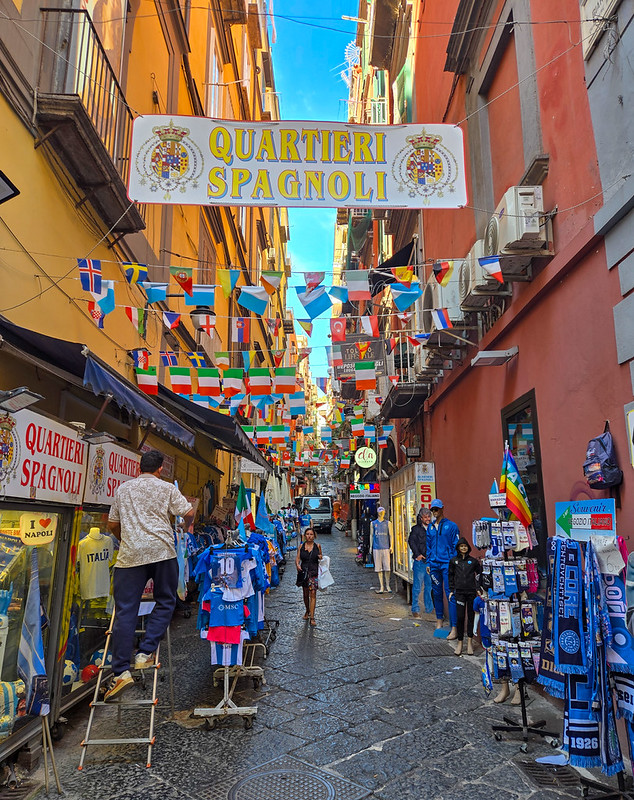
The Spanish Quarter housed the Spanish garrisons in the 16th century. Today, Via Toledo takes you to the entrance of this neighborhood. For many years, this quarter was one of the most dangerous areas in Naples. However, recently it’s transformed into an open-air museum with murals, small tavernas and unique shops. It’s fun to get lost in the narrow alleyways with clothes hanging out the windows. In general, I found a random montage of art, food and quirky charm. You can’t miss all the ecclectic art and murals dedicated to Diego Armando Maradona, the legendery footballer.
I enjoyed my lunch at Hosteria Toledo 1951. My carbonara with mozzarella, egg and bacon with fried spinach and pecorino was delicious! I didn’t make it to the Pedamentina. This flight of 400 steps goes to the Certosa di San Martino on Vomero hill alongside the Castel Sant’Elmo.
Piazza Dante

Being a literary nerd, stumbling across this Piazza Dante felt like serendipity! At the end of Via Toledo is this square with the 19th century statue of Dante Alighieri, a national poet. His Divine Comedy is one of the most important poems of the Middle Ages. It’s considered the greatest literary works in Italian language. On the northwestern side of Piazza Dante is Port’ Alba. It’s a remaining, ancient city gate in Naples.
Antica Pizzeria Port’Alba “World’s First Pizzeria”

Searching the Port Alba neighborhood for this pizzeria is when Napoli first got under my skin. I realized that pizza was not the only destination in Naples. However, pizza is a good start to exploring the city.
Established in 1738, the Antica Pizzeria Port’Alba served the world’s first pizza. Originally made by street vendors, it became a restaurant in 1830. The ovens were made with lava rocks from Mt. Vesuvius. The ingredients were simple, made for people with little money. Patrons honored the pizza by creating poetry.
They introduced pizza marinara with just dough, tomato sauce and toppings such as, olive oil, basil, oregano and garlic. Similarly, the Pizza Margherita is the marinara ingredients with cheese. This pizza highlights the colors of the Italian flag, with the white dough, red tomato sauce and green basil. That’s what I call patriotic pizza!
Museo Archeologico Nazionale di Napoli (MANN)

I can’t recommend this museum enough, especially for those interested in Pompeii and Herculaneum. Much of the art recovered from these ruins is exhibited at MANN. I spent a half-day at the museum and will do my best to sum up highlights.
The National Archaeological Museum of Naples houses a collection that includes works from Greek, Roman and renaissance times. Most importantly, it displays Roman artifacts from the nearby Pompeii, Stabiae and Herculaneum. Overall, the MANN houses an awe-inspiring collection of around 400,000 artifacts and antiquities. Although many are preserved in storage vaults.
The Sundial Hall
For 150 years, the Sundial Hall was a part of the Royal Library and later National Library. Today, this grandiose room showcases important statues and paintings mostly from the Roman period. Created in 1791, the sundial still works today.
Iconic statues in the Sundial Hall include the Roman bronze sculptures of the runners preparing for the Greek Olympics. These became recovered from Villa of the Papyri at Herculaneum. Also, the large Farnese marble statues of Atlas and Athena display here.

The Farnese Marbles make up most of the classical sculpture collection. These are Roman copies of classical Greek sculptures. Iconic ones to see at MANN include the statues of Hercules, Atlas and Farnese Bull.
The MANN exhibits a Mosaic Collection and frescoes recovered from Pompeii and Herculaneum ruins. This includes the Alexander Mosaic from the House of the Faun in Pompeii. Another mosaic depicts a gladiator from the Villa of the Figured Capitals in Pompeii.
The Secret Cabinet (Gabinetto Segreto) houses the collection of erotic artifacts and paintings from Pompeii and Herculaneum. There are many phallic-themed paintings and items. The erotic mythological paintings are the largest group recovered from Vesuvian cities.
The MANN houses some of the most famous Roman and Greek portraits in the world, recovered from Pompeii and Herculaneum. I observed the portrait of the baker, Terentius Neo and his wife. Next to it is the portrait of the poet Sappho with her stylus and wax tablet.
Spaccanapoli Area
Spaccanapoli “Naples Splitter” Street
The Spaccanapoli thoroughfare known as the “Naples Splitter,” is perfect for a walking tour. From the hills above, this strait and narrow street appears to split the city in two. Take note that its street names are different. It starts at Piazza Gesu Nuovo, named as Via Benedetto Croce. Later the street changes to Via S. Biagio dei Librai.
Many important historic landmarks lie along or near this street. For example, sites along the Spaccanapoli include Piazza San Domenico Maggiore, Santa Chiara Monastery Complex, Christmas Alley, Purgatory Lane, Naples Cathedral and Underground Naples.
Santa Chiara Monastery Complex

The Santa Chiara Monastery Complex lies on the Spaccanapoli. Built in the 14th century, this citadel consisted of 2 convents. Currently, it’s restored in the original Gothic style. Overall, the complex includes the church, monastery, tombs and archeological museum. The cloister is especially picturesque and known as an Instagram hotspot.
I just explored the beautiful cloister art and gardens. Its two walkways intersect the gardens into 4 areas. Octagonal pillars line the paths with benches. (No sitting on benches.) Both the pillars and benches are decorated with colorful tiles in popular mythological and rural scenes. The cloister’s 4 walls showcase 17th century frescoes. They depict saints and scenes from the Old Testament.
Christmas Alley or “Street of Nativity Scenes”
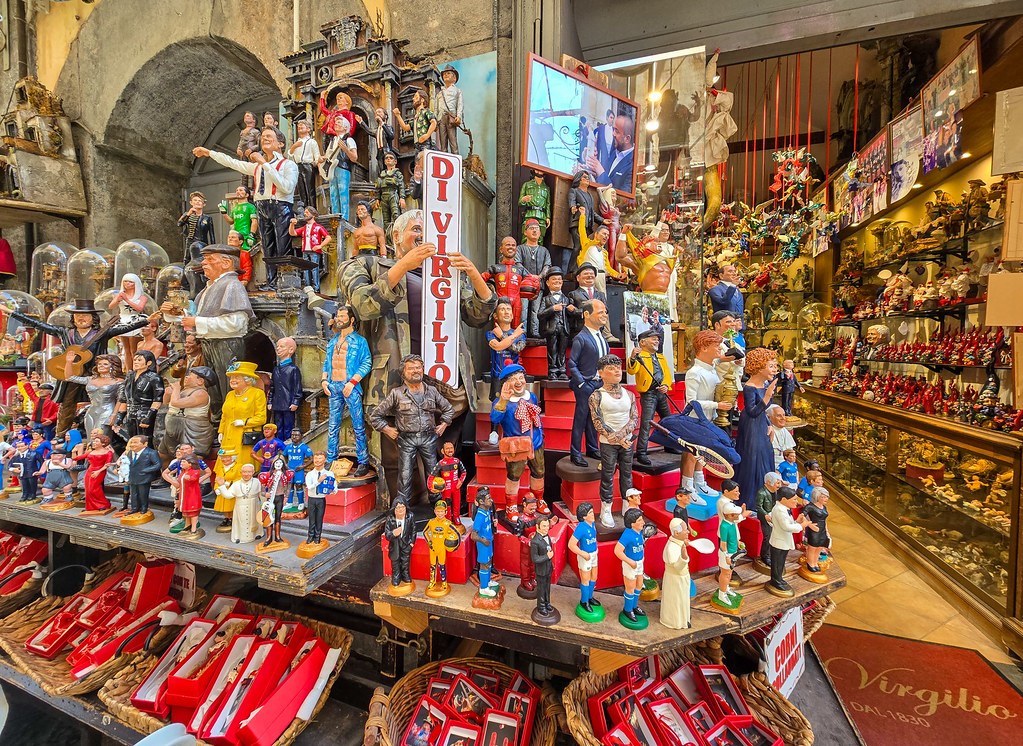
Just off Spaccanapoli, this nativity artisan street is popular all year round. However, as you get closer to Christmas, the street gets more crowded. In Naples on December 8th is the Feast of the Immaculate Conception. This is when the locals bring out their nativities at home and in public. The nativity art displays scenes from the bible, and even figures of politicians or celebrities.
Workshops line up here with artisans that handcraft the nativity figurines. It’s a great opportunity for shopping and experiencing a Neapolitan tradition that’s been around for centuries.
Rub Pulcinella’s Nose for Luck

I stumbled across another Neapolitan tradition in my meanderings near the Spaccanapoli on Purgatory Lane. Here, is the Vico del Fico Al Purgatorio, a statue of Pulcinella. This puppet character came from commedia dell’arte in the 17th century. He is said to be everyone’s savior, despite being a rebel and derelict.
Join the line and find out what all the fun is about! By touching Pulcinella’s large nose, you receive good luck and prosperity.
Naples Cathedral

Naples is the “city of 1,000 churches.” I sought out the Naples Cathedral, because it’s one of the most important churches of worship in the city. Near Spaccanapoli, it’s also known as the Cathedral of Saint Januarius, honoring the city’s patron saint. This Gothic church is the oldest baptistery in the western world. It houses a vial of Saint Januarius’ blood. Three times per year the blood is taken out, when it usually liquefies. Legend goes that if the blood doesn’t liquefy, then a disaster will destroy Naples.
Naples Underground
Aka, Napoli Sotterranea is on Via dei Tribunali near the Spaccanapoli. This multi-layered subterranean world is the only landmark that I missed in this article. Originally, in the 4th century BC, the Greeks quarried the volcanic tuff to build temples and houses. These cavities left behind a network that the Romans later developed into aqueducts. Later, during WW II, they used this for bomb shelters. Naples Underground offers guided tours to get unique perspective on the rich history of this city.
Napoli Waterfront Landmarks
Castel Nuovo

You can’t miss the imposing medieval Castel Nuovo in front of Piazza Municipio near the cruise terminal. Since the 13th century, it’s been one of the main landmarks in the city. It was the royal seat for kings until the 19th century. Today, it’s a museum and site for Neapolitan Society of Homeland History.
Lungomare Caracciolo
This is Naples’ waterfront promenade stretching from Castel dell-Ovo towards Mergellina. On a clear day, you can see Mt. Vesuvius, Capri and Sorrentine Peninsula. It’s a refreshing break from the city’s monuments for some sea air and views.
Castel dell’Ovo

On a peninsula along the Lungomare Carracciolo stands the Castel dell’Ovo. It’s also called the “Egg Castle,” named after a legend. Supposedly, the Roman poet, Virgil put a magical egg in its foundation to strengthen fortifications. Remaining there with his bones, if the egg breaks, legend goes that a disaster will befall Naples. It was closed for renovations when I was there. Take note that Capri Island is visible behind the castle.
Naples Day Tours

Napoli is the perfect hub from which to explore the incredible sites of southern Italy. Check out my travel guides on Pompeii, Herculaneum and Mt. Vesuvius. I still need to explore more Capri and Amalfi Coast.
Ancient Pompeii Self-Guided Tour with 15 Points of Interest
Herculaneum Sightseeing Guide and 10 Points of Interest
Vesuvius on Foot: A Hike to the Crater

Final Thoughts…
Naples for me was a journey, not just a destination. It literally took me years to finally realize that this entire city is a hidden gem. It’s heartbreaking that Napoli became underrated and buried under politics, mafia and waste mismanagement. Perhaps, like Pompeii, it’s time for the world to excavate Napoli and repolish its rich history and reclaim its former glory. If your travels bring you to Naples, feel free to leave tips below.
