
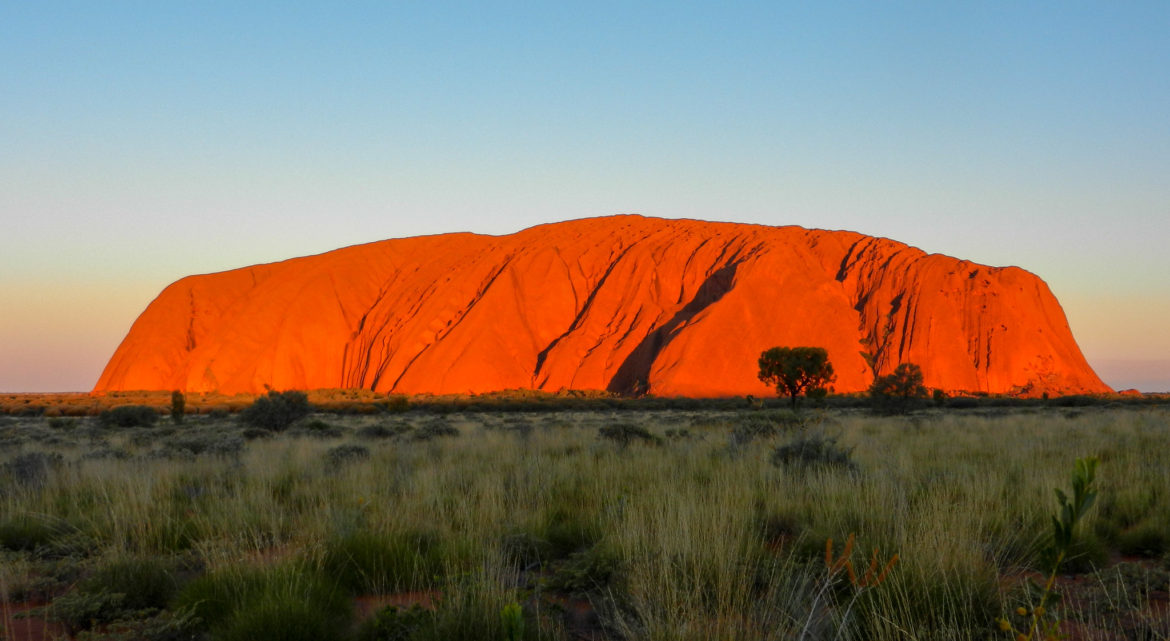
Uluru and Kata Tjuta are the heart of Australia. It’s not a place for a whirlwind get a photo and leave. You sink into its ancient essence over time. At some level, I knew this ahead of time and scheduled 3 days and 4 nights. I can’t really say this experience felt like travel or a getaway. It felt more like a spiritual retreat. I recommend to anyone reading this, consider slow travel here allow this place change you. Read on to discover how to plan an Australia’s Uluru-Kata Tjuta aka Ayers Rock and Olgas retreat.
Uluru was considered sacred for thousands of years by the Anangu, Aboriginal people in Australia’s red centre. I wanted to tap into the roots of it, beyond the exploited postcard image known as “Ayer’s Rock.” At Uluru, the geological and mystical dimensions are infinite, with many ways to explore this iconic landmark. Join me on my walkabout exploring this sacred site.
Accommodations in Yulara
The town Yularais just 10 minutes from the Uluru-Uluru-Kata Tjuta National Park entrance. I stayed here at the Aboriginal-owned Ayers Rock Resort for four nights. I loved everything about it, being conveniently located with restaurants, a supermarket and even a day spa. Also, they offered shuttles to Uluru.
Uluru is an inselberg or “Island mountain”
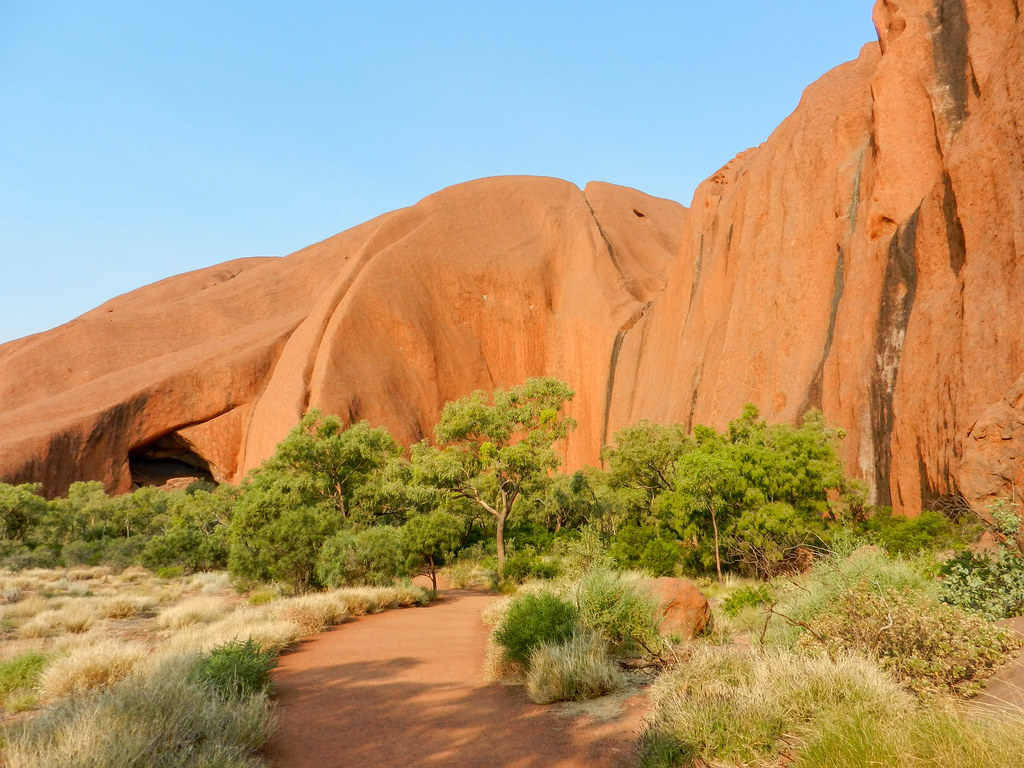
This monolithic landmark stands alone as an inselberg, literally an “island mountain” as a vestige of an eroded mountain range. Its solitary, megalithic presence is almost intrusive on your senses! It stands at 345 m high, with a circumference of 9.4 km. Secretly, it is a part of an underground mountain range, submerged 5 – 6 km below the earth. This includes the nearby Kata Tjuta and Mt. Connor.
The sandstone and feldspar, with iron-bearing minerals, oxidize to create the looming red presence. Uluru’s unique geological feature is its homogeneity of the rock and lack of jointing, leading to minimal development of scree. This feature is what lead to its longevity and survival, while the surrounding rocks eroded away.
Australia’s Uluru-Kata Tjuta Retreat
aka Ayers Rock & Olgas
Uluru Sunrise/Sunset Walks with Anangu People

I took a morning and an afternoon/sunset walk with Anangu people, planned through an Aboriginal organization. I wanted to connect with the Aboriginal dreamtime stories of Uluru and learn more about this ancient, rich culture in their indigenous environment. After watching the sunrise over Uluru, I went on a morning Liru Walk. This was lead by an Aboriginal man with an interpreter from the Cultural Centre to the base of Uluru.
He demonstrated how to make spears and the coolamon from tree trunks (carrier balanced on top of head by women). There was an eclectic array of flowers along the way sprinkled on the red dirt. This year the Red Centre received the most rain in 50 years. So the mulga tree groves were brightened with flora, such as, lavender, honey grevillea, desert red pea and pink everlastings.
Kuniya Walk for Bush Medicine
Australia’s Uluru-Kata Tjuta Retreat

In the late afternoon and evening, I went on the Kuniya Walk lead by an Aboriginal woman to explore the terrain for bush food and medicine; plus, learn a Dreamtime Creation Story. I discovered my favorite sanctuary of Uluru at Mutijulu waterhole, where there cross-pollinates a plethora of inspirational sites. Immediately, I felt a serenity and silence so empowering, that my mind acquiesced to being quiet in deep contemplation.
Aboriginal Myth
Dreamtime Creation Story

The Aboriginal Guide told the Dreamtime story about the Battle of Liru. A venomous snake and Kuniya, a young woman python. Long, long ago during the Creation or Dreamtime Period (Tjukurpa) the Kuniya was ambushed by the Liru (poisonous snakes) and killed by spears. The spears that missed made holes in the Uluru rock, that are still there. Kuniya’s aunt was so upset that she killed one of the Liru with a blow to the head. The blood flowing from the head of the dead Liru can still be seen.
This is just one of many Aboriginal creation or Dreamtime stories about Uluru. These explain the unique, physical features of this natural monument. Interestingly, while observing the landscape of this story, we discovered a large monitor lizard camouflaged alongside the canyon wall. He remained there as a silent messenger of stillness for us all to observe.
Bush Food & Medicine with Coolamon

The Aboriginal woman and interpreter picked samples of bush food and medicine, collecting them in the coolamon. We observed the ochre paintings on the canyon walls. I learned that concentric circles indicate a waterhole and the yellow flower, the honey grevillea.
By the end of the walk, the coolamon had grown into a colourful cornucopia of bush food. We sampled the desert peaches and figs that were very tasty. However, they are smaller and less sweet than the ones from the U.S.
The desert inspires the natural kingdom to be creative and resourceful with food, based on survival needs. Gluttony just doesn’t belong in this environment. We ended the day with my second sunset viewing at Uluru. It was even more muted than the night before, due to the bush fire haze. I started to admit my disappointment in the gray skies from the haze, and accept that I may miss out on the luminescent, red reflections that Uluru is known for at sunset.
Helicopter Ride
Australia’s Uluru-Kata Tjuta Retreat


The next day was a whirlwind starting off with a helicopter ride over Uluru, accentuating even more the disproportionate inselberg of Uluru and Kata Tjuta from a seemingly flat, endless spinifex landscape.

Walk at Kata Tjuta’s “Olgas” Walpa Gorge
In the afternoon, I went on a walk to Walpa (meaning “windy”) Gorge at Kata Tjuta. From the same underground mountain range as Uluru, is Kata Tjuta aka the “Olgas” or “many heads.” This name is due to its dome-like sandstone formations. In my walk we followed a path along a peaceful stream through the gorge between 2 sandstone domes to a grove of spearwood trees.
The unique ecosystem at this area grows plants that exist nowhere else in the world. I don’t mean to undermine the magnificence of Kata Tjuta because it is as spectacular as Uluru in its own unique way.

My Uluru or “Ayers Rock” Walkabout

The culmination and highlight of all my experiences at Uluru was my 4-hour, 10 km Walkabout around the base of Uluru. Obviously, plan this for an early morning start. Because I was there in Australian winter, the temperature was fine for me. I took my time and really stopped to notice and experience everything along the way.
There was a superbloom of flowers for me to explore along the way, following a year with more rain than usual here. So, exploring the plant life and the details of the rock formations was fascinating. Mother Nature is truly an artist and you realized that very much here.
Three Uluru Sunset Viewings

Finally, on my third sunset viewing, I joyously see the renowned sunset, illuminating Uluru’s primary red spectrum of light. The winds had shifted, blowing the bush fire smoke away, leaving clear skies for a bright sunset. This made it possible for Uluru to reflect its bright neon red lights, about 10 minutes before the sun sinks below the horizon. These fleeting moments are a portal in time, opening a glimpse into eternity, when the sunset ignites Uluru into electric rays of Red Dreamtime.

This perfect storm of circumstances synergistically creates a visual effect so stunning and bright, that you observe in disbelief. Such beauty seems only possible in supernatural realms. However, my pictures are a testament to how real the beauty of Uluru truly is at sunset.

Palya!
Years later, I am back here in heart and soul as I edit this blog. I can truly say, after traveling to 100+ countries, this retreat to Uluru-Kata Tjuta affected me deeply. Still, to this day, I recall how much this journey here transformed me. I can’t recommend enough if you come here, try to make it a retreat, not a travel destination. Give it enough time and Uluru will change your life.
Read Next!
Central Australia Outback Tours at West MacDonnell N.P., Finke Gorge & More
Perth, Australia’s Top 10 Attractions – World’s Most Remote City